I'll come right out and say it: I'm addicted to blogs. I write a blog of my own and I follow 78 blogs of varying topics and themes. You heard right: SEVENTY-EIGHT. I really should get some help. Now I know that, like me, you've been following the Archives Month blog avidly this past week, but there are many other archives blogs out there to add to your blogroll. The archives blogs I follow introduce me to new issues and debates within the archival community, or just give me a fun story for the day. While I follow quite a few archives blogs, I'm going to highlight just a few of my favorites today.
1. ArchivesNext.
This is the NBC newsroom of the archival world, chock-full of breaking news and ongoing debates and discussions. It also features a lot of guest posts from archivists, archival students, and professors, which broadens the blog's horizons. Recent headlines include: "Dramatic Change to NARA's Mission in New Strategic Plan?", "Spontaneous Scholarship for 2013 SAA Annual Meeting: How to Give, How to Apply", and "Gauging Interest in Group for 'Mid Career' Archivists." I can't help but feel up-to-date when I read this blog.
2. ArchiveGrid Blog.
So..... I love ArchiveGrid. Easy to search, easy to explain to patrons, and just fun to explore. And this blog is a lot of fun too. It provides updates and news about ArchiveGrid (like a post last week about Archival Descriptive Standards) but most of the time, it focuses on the collections and contributors to ArchiveGrid. Last month, a post about lunchboxes. Last week, a post about civil rights. This week, the George Washington Presidential Library. You never know what story you'll find on ArchiveGrid.
3. NARAtions. (Clever name, or what?)
Although the NARA blog is currently down (thank you, Congress), it should be back up and running when this temper tantrum is over. Aside from the politics, NARAtions is worth checking out. Like ArchiveGrid, it contains news about their institution, but also includes stories about particular collections or manuscripts, often with pictures. As someone who assists patrons with a lot of genealogy research, I also appreciate the updates about new records available on their website or tips on researching specific record groups. Thanks NARA!
4. Found in the University Archives.
I have to give a plug to UW-Madison here, and it's a plug I don't mind giving. Found in the University Archives is a fun blog, full of pictures, videos, and lots of really unique stories, all related to our fantastic school. It's a little off the wall (Oompa Loompas, anyone?), but that's what makes it catchy and exciting to follow. You never know what is going to be posted next. The blog is also an excellent example of how to use social media to promote archives and get people excited about "the old stuff."
There are many more I could prattle on about, but then I might be here all day. However, here are some other blogs you shouldn't miss: Off the Record (SAA's blog), Derangement and Description (check out the post they did when Disney acquired LucasFilm last year), the Smithsonian Collections blog, and Conservators Converse (the blog for the American Institute for Conservation.) A lot of archives and special collections do their own blogs as well, so if you have a favorite archive or library (mine is the National Library of Ireland), see if they have a blog to follow! Now if you'll excuse me, I have some blogs to read.
Showing posts with label university archives. Show all posts
Friday, October 4, 2013
Tuesday, October 16, 2012
Exploring the Aldo Leopold Archives
Aldo Leopold was a professor at UW Madison beginning in 1933 in the Agricultural Economics Department. 27.6 cubic feet of the Aldo Leopold Archives are housed at the University Archives and have been digitized and put online. I also examined Special Collection’s smaller Aldo Leopold manuscript collection, collected by Robert McCabe, Leopold’s former student and friend.
Aldo Leopold is considered by many to have been the most influential conservation thinker of the 20th Century. Leopold's legacy spans the disciplines of forestry, wildlife management, conservation biology, sustainable agriculture, restoration ecology, private land management, environmental history, literature, education, esthetics, and ethics. He is most widely known as the author of A Sand County Almanac, one of the most beloved and respected books about the environment ever published. The Leopold Collection houses the raw materials that document not only Leopold's rise to prominence but the history of conservation and the emergence of the field of ecology from the early 1900s until his death in 1948.
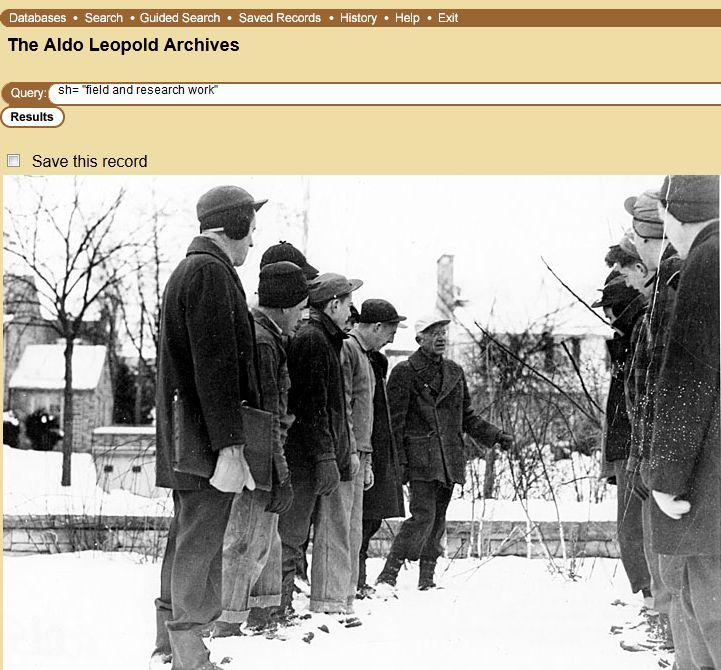
Aldo Leopold with students.
Aldo and Starker boating near the Shack, Sauk County, Wisconsin, autumn 1943
The online collection was very user friendly; it was easy to browse subject headings and search by keyword. I found that the best use of this was looking through photographs and paging through journals and essays. The finding aid for this collection is very detailed, and is explained in the “How to Use The Collection” portion of the website. Again, from the website:
The digitization of the Leopold Collection will serve scholars, policy leaders and the general public who look to Aldo Leopold for insight and inspiration on how to deal with complex conservation challenges facing society in the 21st Century.
As much as I liked exploring the collection online, I wanted to go to the actual repositories around campus to look through the collections. I visited Special Collections first, since this is a smaller Leopold collection. These papers, collected by Robert McCabe, range from 1920-1940. There were many photographs and course materials here as well, but I enjoyed looking through Leopold’s early drafts of published and unpublished essays with notes scrawled in the margins. Susan Stravisnki showed me the detailed finding aid that they have on file for this particular collection.
Next I went to the University Archives, located in Steenbock Memorial Library. David Null helped me identify some interesting papers, journals, and artifacts that would work well for a blog post. I looked through Aldo Leopold’s field journals, some memorabilia, and (surprisingly) his artwork. I spent most of my time there reading journals, which described canoeing and hunting trips around Wisconsin.
One of the most interesting folders was labeled “Contents of A.L.’s Pockets Upon His Death.” Leopold died at 61 of a heart attack as he was fighting a fire on his neighbor’s property.
I just scratched the surface of this fantastic collection. Aldo Leopold’s contributions to conservation and ecology are so influential to UW Madison and the state of Wisconsin. To find out more, check out the archives online, at the University Archives, or at Special Collections. One area that I did not explore are the Oral Histories involving Leopold, also at the University Archives.
[Post Created by Lotus Norton-Wisla]
[Post Created by Lotus Norton-Wisla]
Tuesday, October 2, 2012
Not Your Ordinary Map
One of the greatest parts of living in Madison is the beauty of the city. Not only is Madison an isthmus, providing an abundance of natural beauty, but the architecture and character of the city is unique as well. I'm amazed at how the landscape of the city is always changing. If you've ever lived in an university town I'm sure you're familiar with the construction and renovation projects that are constantly reshaping the campus.
The University Archives here in Madison offers users the chance to freeze time and catch a glimpse of the Madison of the past. They have done this by creating an account on Historypin.
Historypin was created by the not for profit company We Are What We Do, and works in conjunction with Google. What this means is that anyone can can upload photos, enter the photo's date and location if they know them, and anchor the photo to a Google map. Here's a great example of how the University Archives have used an image of Lathrop Hall from the 1930s and placed it in a modern Google map.
One of my favorite features of the this map view is the user can "Fade" the image out to see what the modern intersection looks like.
The University Archives also has photos besides the UW campus posted on Historypin. Below is a 1959 photo of The Winter Palace in Leningrad, Soviet Union.
So how does all this cool stuff relate to the Wisconsin Idea? Well, the University Archives is doing a lot here to provide a service to the citizens of Wisconsin and beyond. The features of Historypin translate to many different types of users, including academic researchers interested in architecture or city planning, genealogist wanting to visualize where their families lived or attended classes, students working on projects or preparing for a field trip to the University, and enthusiasts of the University wanting to relive their own experiences in Madison. Each type of user may find different reasons to utilize a tool like this.
Currently the University Archives has just three collections on Historypin. I think as they are able to add more collections to this site that excitement and use will grow. So check it out for yourself!. Just go to the University Archives Images page and click the Historypin button, then you're ready to view some wonderful photos from the archives collections.
Or, go the the Historypin Channels page and enter "UWMadArchives".
The University Archives here in Madison offers users the chance to freeze time and catch a glimpse of the Madison of the past. They have done this by creating an account on Historypin.
Historypin was created by the not for profit company We Are What We Do, and works in conjunction with Google. What this means is that anyone can can upload photos, enter the photo's date and location if they know them, and anchor the photo to a Google map. Here's a great example of how the University Archives have used an image of Lathrop Hall from the 1930s and placed it in a modern Google map.
One of my favorite features of the this map view is the user can "Fade" the image out to see what the modern intersection looks like.
The University Archives also has photos besides the UW campus posted on Historypin. Below is a 1959 photo of The Winter Palace in Leningrad, Soviet Union.
So how does all this cool stuff relate to the Wisconsin Idea? Well, the University Archives is doing a lot here to provide a service to the citizens of Wisconsin and beyond. The features of Historypin translate to many different types of users, including academic researchers interested in architecture or city planning, genealogist wanting to visualize where their families lived or attended classes, students working on projects or preparing for a field trip to the University, and enthusiasts of the University wanting to relive their own experiences in Madison. Each type of user may find different reasons to utilize a tool like this.
Currently the University Archives has just three collections on Historypin. I think as they are able to add more collections to this site that excitement and use will grow. So check it out for yourself!. Just go to the University Archives Images page and click the Historypin button, then you're ready to view some wonderful photos from the archives collections.
[Post created by Laura Farley]
Thursday, October 30, 2008
Cofrin Library, Special Collections Department
University of Wisconsin - Green Bay
2420 Nicolet Drive
Green Bay, Wisconsin 54311-7001
Phone: (920) 465-2333
The Special Collections Department of the University of Wisconsin-Green Bay was established in 1972. Having been established only six years after the founding of the University, the repository was able to document the university’s founding and early development in great detail. Along with storing the university’s records and special collections, the department is a member of the Wisconsin Historical Society’s area research center. Patrons are able to access a wide variety of manuscript materials that document the history of Northeastern Wisconsin.
Collections
As one of the 14 members of the Area Research Network, public records and manuscript materials from the counties of Brown, Calumet, Door, Florence, Kewaunee, Manitowoc, Marinette, Menominee, Oconto, Outagamie, and Shawano can be found in the Special Collection Department. The types of materials available include books, census records, photographs, oral histories, Belgian-American research materials, and maps. The University Archives contains complete files of virtually every university-generated publication, departmental and administrative records, and the records of individual faculty members.

Fourth of July Parade, Green Bay, WI ca. 1918.

Postcard of the Bay Beach Pavillion, Green Bay, WI.

Charles Linzmeier farm, ca. 1900. Belgian-American Research Collection.
Images courtesy of Cofrin Library, Special Collections Department, University of Wisconsin - Green Bay.
Entry compiled by Greg Kocken
2420 Nicolet Drive
Green Bay, Wisconsin 54311-7001
Phone: (920) 465-2333
The Special Collections Department of the University of Wisconsin-Green Bay was established in 1972. Having been established only six years after the founding of the University, the repository was able to document the university’s founding and early development in great detail. Along with storing the university’s records and special collections, the department is a member of the Wisconsin Historical Society’s area research center. Patrons are able to access a wide variety of manuscript materials that document the history of Northeastern Wisconsin.
Collections
As one of the 14 members of the Area Research Network, public records and manuscript materials from the counties of Brown, Calumet, Door, Florence, Kewaunee, Manitowoc, Marinette, Menominee, Oconto, Outagamie, and Shawano can be found in the Special Collection Department. The types of materials available include books, census records, photographs, oral histories, Belgian-American research materials, and maps. The University Archives contains complete files of virtually every university-generated publication, departmental and administrative records, and the records of individual faculty members.

Fourth of July Parade, Green Bay, WI ca. 1918.

Postcard of the Bay Beach Pavillion, Green Bay, WI.

Charles Linzmeier farm, ca. 1900. Belgian-American Research Collection.
Images courtesy of Cofrin Library, Special Collections Department, University of Wisconsin - Green Bay.
Entry compiled by Greg Kocken
Wednesday, October 29, 2008
University of Wisconsin- University Archives and Records Management Services
425 Steenbock Library
550 Babcock Drive
Madison, WI 53706-1201
Phone: (608) 262-5629
Archives: uwarchiv[at]library.wisc.edu
Records Management: recmgmt[at]library.wisc.edu
Iconograhy: bschermetzler[at]library.wisc.edu
Oral History: oralhist[at]library.wisc.edu
http://archives.library.wisc.edu/
The University of Wisconsin-Madison Archives was founded in 1951 with the mandate to preserve University records, records management services and serve as an educational resource promoting the University. The repository also serves as the official repository of the UW-Extension and UW-Colleges systems. There are four main sections of the archives: the Archives proper, the Records Management Service, the Iconography section, and the Oral History Program. The UW Archives is part of the General Library System, and as such collaborates with UW Digital Collections to make collections available on-line.
Collections
The UW-Archives houses collections related to the history of the University, covering topics such as academics, athletics, and student life. Several university publications, including the Badger Yearbook and Wisconsin Alumni Magazine, are available in full-text through UW Digital Collections.
The UW-Records Management Service establishes the records retention schedules for the University administration. The Service maintains records liaisons with the academic departments to ease the process of records collection. Records are preserved by the service for legal, financial, historical and administrative purposes.
The Iconography section houses visual materials related to the University. Particularly significant are the photograph collections of the Daily Cardinal, and the Badger Yearbook. Popular photo collections include the UW-Madison Chancellors, UW-Madison Athletics, the Wisconsin Union, and Madison Protests. The total image collection is more than 2,500,000 images. Many images are available on-line through UW Digital Collections.
The Oral History Program began in 1972 and has collected over 800 interviews to date. The bulk of the interviews concern academic staff and the events of their tenure at the University. About one third of interviews were taken as parts of special projects covering topics such as the UW Merger, the Arboretum, and the Teaching Assistants Strike of 1970. Current projects include interviews of the UW-Forest Products Lab and the Madison LGBT community.

Students, 1879. Students pose in front of Bascom Hall.

Etching of Campus, 1890. The campus as it appeared around 1890. The large building in the background is Bascom Hall.

Composite Photograph, UW Home. The composite photograph developed by UW Digital Collections for the University of Wisconsin- University of Wisconsin- University Archives and Records Management Services webpage.
Images courtesy of the University of Wisconsin- University Archives and Records Management Services.
Entry compiled by Tyler Kennedy
550 Babcock Drive
Madison, WI 53706-1201
Phone: (608) 262-5629
Archives: uwarchiv[at]library.wisc.edu
Records Management: recmgmt[at]library.wisc.edu
Iconograhy: bschermetzler[at]library.wisc.edu
Oral History: oralhist[at]library.wisc.edu
http://archives.library.wisc.edu/
The University of Wisconsin-Madison Archives was founded in 1951 with the mandate to preserve University records, records management services and serve as an educational resource promoting the University. The repository also serves as the official repository of the UW-Extension and UW-Colleges systems. There are four main sections of the archives: the Archives proper, the Records Management Service, the Iconography section, and the Oral History Program. The UW Archives is part of the General Library System, and as such collaborates with UW Digital Collections to make collections available on-line.
Collections
The UW-Archives houses collections related to the history of the University, covering topics such as academics, athletics, and student life. Several university publications, including the Badger Yearbook and Wisconsin Alumni Magazine, are available in full-text through UW Digital Collections.
The UW-Records Management Service establishes the records retention schedules for the University administration. The Service maintains records liaisons with the academic departments to ease the process of records collection. Records are preserved by the service for legal, financial, historical and administrative purposes.
The Iconography section houses visual materials related to the University. Particularly significant are the photograph collections of the Daily Cardinal, and the Badger Yearbook. Popular photo collections include the UW-Madison Chancellors, UW-Madison Athletics, the Wisconsin Union, and Madison Protests. The total image collection is more than 2,500,000 images. Many images are available on-line through UW Digital Collections.
The Oral History Program began in 1972 and has collected over 800 interviews to date. The bulk of the interviews concern academic staff and the events of their tenure at the University. About one third of interviews were taken as parts of special projects covering topics such as the UW Merger, the Arboretum, and the Teaching Assistants Strike of 1970. Current projects include interviews of the UW-Forest Products Lab and the Madison LGBT community.

Students, 1879. Students pose in front of Bascom Hall.

Etching of Campus, 1890. The campus as it appeared around 1890. The large building in the background is Bascom Hall.

Composite Photograph, UW Home. The composite photograph developed by UW Digital Collections for the University of Wisconsin- University of Wisconsin- University Archives and Records Management Services webpage.
Images courtesy of the University of Wisconsin- University Archives and Records Management Services.
Entry compiled by Tyler Kennedy
Thursday, October 23, 2008
Alverno College Archives
Corona Hall Room B8
3335 S. 39th St.
Milwaukee, WI 53215
Mailing Address:
3400 S. 43rd St
P.O. Box 343922
Milwaukee, WI 53234-3922
Phone: (414) 382-6202
Fax: (414) 382-6354
E-Mail: archives[at]alverno.edu
Sara Shutkin, Archivist/Records Manager
In the summer of 1974, Sr. Joel Read, then Alverno College President and a historian by training, asked Sr. Joanne Barras (1916-1990), a retired business education instructor, to become the first Alverno College Archivist. Then Sr. Joanne went through extensive training. The Archives was officially established in January 1975 with a campus-wide memo from Sr. Joel and a Winter Institute presentation by Sr. Joanne both outlining the program in considerable detail. In October 1978, the Archives became a unit of the Alverno College Library. A records management program in conjunction with the college archives program was added in the spring of 1987. The Archives became the official repository of the SWITCH (Southeastern Wisconsin Information Technology Exchange) Consortium in 1997.
Throughout its history, the Alverno College Archives has had a reputation for quality service. The Archives is currently staffed by one full-time archivist/records manager, Sara Shutkin and a half-time archives assistant, Debra Butz.
Collections
The Alverno College Archives is a unit of the Alverno College Library. The Archives houses about 1627 linear feet of college records of enduring historical, administrative and legal value in a variety of formats including paper, photographs, microforms, audiotapes, and videotapes.
Collections of note include those documenting the Research Center on Women (RCW) and Alverno's unique ability-based curriculum.
The records of the SWITCH Consortium, of which Alverno is a member, are also housed in the Archives.

Happy Birthday, Alverno! Alverno celebrated its Centennial with 21 different events held throughout the year in 1987.

The cornerstone for the ‘New Alverno College’ was laid on Sunday October 19, 1952. It was a cold and blustery day.

Sr. Marian Shreiner in the Research Center on Women. It was established in April 1970.
Images courtesy of the Alverno College Archives. To view more images, check out their web page, in particular the “Timeline of Alverno College History": http://depts.alverno.edu/archives/archome/timeline.html
Entry compiled by Christina Johnson
3335 S. 39th St.
Milwaukee, WI 53215
Mailing Address:
3400 S. 43rd St
P.O. Box 343922
Milwaukee, WI 53234-3922
Phone: (414) 382-6202
Fax: (414) 382-6354
E-Mail: archives[at]alverno.edu
Sara Shutkin, Archivist/Records Manager
In the summer of 1974, Sr. Joel Read, then Alverno College President and a historian by training, asked Sr. Joanne Barras (1916-1990), a retired business education instructor, to become the first Alverno College Archivist. Then Sr. Joanne went through extensive training. The Archives was officially established in January 1975 with a campus-wide memo from Sr. Joel and a Winter Institute presentation by Sr. Joanne both outlining the program in considerable detail. In October 1978, the Archives became a unit of the Alverno College Library. A records management program in conjunction with the college archives program was added in the spring of 1987. The Archives became the official repository of the SWITCH (Southeastern Wisconsin Information Technology Exchange) Consortium in 1997.
Throughout its history, the Alverno College Archives has had a reputation for quality service. The Archives is currently staffed by one full-time archivist/records manager, Sara Shutkin and a half-time archives assistant, Debra Butz.
Collections
The Alverno College Archives is a unit of the Alverno College Library. The Archives houses about 1627 linear feet of college records of enduring historical, administrative and legal value in a variety of formats including paper, photographs, microforms, audiotapes, and videotapes.
Collections of note include those documenting the Research Center on Women (RCW) and Alverno's unique ability-based curriculum.
The records of the SWITCH Consortium, of which Alverno is a member, are also housed in the Archives.

Happy Birthday, Alverno! Alverno celebrated its Centennial with 21 different events held throughout the year in 1987.

The cornerstone for the ‘New Alverno College’ was laid on Sunday October 19, 1952. It was a cold and blustery day.

Sr. Marian Shreiner in the Research Center on Women. It was established in April 1970.
Images courtesy of the Alverno College Archives. To view more images, check out their web page, in particular the “Timeline of Alverno College History": http://depts.alverno.edu/archives/archome/timeline.html
Entry compiled by Christina Johnson
Monday, October 20, 2008
Lawrence University Archives
Seeley G. Mudd Library113 S. Lawe Street
Appleton, WI 54911
E-mail: archives@lawrence.edu
Voice: 920-832-6753
http://www.lawrence.edu/library/archives/
The Lawrence University Archives is comprised of the historically
significant records of Lawrence University and Milwaukee-Downer College,
the latter an all women’s college that consolidated with Lawrence in
1964. Collections include the records of Lawrence presidents and
faculty, student organizations, and a vast array of photographs and
scrapbooks from both Lawrence and Milwaukee-Downer College. There are
currently about 100 collections. The Archives also houses a collection
of published materials, including LU and MDC yearbooks, student
newspapers, and books on Lawrence’s rich history. The Archives preserves
and provides access to the historical resources in these collections.

The Milwaukee-Downer College Hat Hunt was a popular annual tradition.
This photograph is from the 1940s.

The Milwaukee-Downer College annual regatta, 1940s. When Milwaukee-Downer College merged with Lawrence in 1964, one of the activities they brought and continued at Lawrence was crew.

The ROCK, a boulder brought to the Lawrence campus in the 1890s, is a
Lawrence tradition and has been moved around campus in the past 100
years. A tradition is for graduates to have their picture taken with
this icon. This photograph was taken around 1960.
Top image: Main Hall, built in 1857, is the oldest building on Lawrence's campus. The photograph was taken around 1860.
Images courtesy of the Lawrence University Archives.
Entry compiled by Casey Coleman
Friday, October 17, 2008
Archives Department of the University of Wisconsin-Milwaukee Libraries
University of Wisconsin—Milwaukee
P.O. Box 604
Milwaukee, WI 53201-0604
(414) 229-5402
http://www.uwm.edu/Libraries/arch/index.html
The Archives Department has the two-fold mission of documenting the history of UWM and providing access to primary sources, largely from the metropolitan Milwaukee area, that have long-term research and instructional value for UWM academic programs. We also respond to the information needs of researchers worldwide, provide instruction sessions for UWM courses, host an annual lecture on local history, and display our holdings on campus and in the community.
The Archives serves the university’s historical needs by preserving and making accessible the records of UWM and its predecessor institutions. We acquire records from all levels of the university, including administrative and governance units; schools, colleges, and academic departments; athletic programs; and student organizations. The Archives also has a rich photograph collection, blueprints for most campus buildings, student newspapers, a complete run of yearbooks from 1896 to 1968, athletic films, and taped interviews with campus administrators. To assist in the preservation of UWM’s history, we administer the campus records management program.
The Archives supports research and instruction at UWM by providing access to historically significant papers and records created or collected by individuals and organizations in the course of their activities. Collection strengths pertain to the following subject areas: social justice; racial, ethnic, and other underrepresented populations; Milwaukee's brewing industry; and the historical development of the archives profession in the United States.
The Archives provides further access to primary sources by serving as an Area Research Center (ARC) of the Wisconsin Historical Society (WHS). The Milwaukee ARC Collection includes birth, death, marriage, naturalization, probate, and property records for Milwaukee, Ozaukee, Sheboygan, Washington, and Waukesha counties. By participating in this statewide network of ARCs, the Archives is able to provide local access to the holdings of the WHS and other ARCs via the ARC transfer system.

UWM Homecoming, 1957. UWM Photographic Services Records (UWM Archival Collection 6)

Plant of the Pabst Brewing Co., pre-1915. Thomas and Jean Ross Bliffert Postcard Collection (UWM Manuscript Collection 171)

Black Student Protest, 1969. UWM Photographic Services Records (UWM Archival Collection 6)
Images courtesy of the Archives Department of the University of Wisconsin-Milwaukee Libraries.
Entry compiled by Casey Coleman
P.O. Box 604
Milwaukee, WI 53201-0604
(414) 229-5402
http://www.uwm.edu/Libraries/arch/index.html
The Archives Department has the two-fold mission of documenting the history of UWM and providing access to primary sources, largely from the metropolitan Milwaukee area, that have long-term research and instructional value for UWM academic programs. We also respond to the information needs of researchers worldwide, provide instruction sessions for UWM courses, host an annual lecture on local history, and display our holdings on campus and in the community.
The Archives serves the university’s historical needs by preserving and making accessible the records of UWM and its predecessor institutions. We acquire records from all levels of the university, including administrative and governance units; schools, colleges, and academic departments; athletic programs; and student organizations. The Archives also has a rich photograph collection, blueprints for most campus buildings, student newspapers, a complete run of yearbooks from 1896 to 1968, athletic films, and taped interviews with campus administrators. To assist in the preservation of UWM’s history, we administer the campus records management program.
The Archives supports research and instruction at UWM by providing access to historically significant papers and records created or collected by individuals and organizations in the course of their activities. Collection strengths pertain to the following subject areas: social justice; racial, ethnic, and other underrepresented populations; Milwaukee's brewing industry; and the historical development of the archives profession in the United States.
The Archives provides further access to primary sources by serving as an Area Research Center (ARC) of the Wisconsin Historical Society (WHS). The Milwaukee ARC Collection includes birth, death, marriage, naturalization, probate, and property records for Milwaukee, Ozaukee, Sheboygan, Washington, and Waukesha counties. By participating in this statewide network of ARCs, the Archives is able to provide local access to the holdings of the WHS and other ARCs via the ARC transfer system.

UWM Homecoming, 1957. UWM Photographic Services Records (UWM Archival Collection 6)

Plant of the Pabst Brewing Co., pre-1915. Thomas and Jean Ross Bliffert Postcard Collection (UWM Manuscript Collection 171)

Black Student Protest, 1969. UWM Photographic Services Records (UWM Archival Collection 6)
Images courtesy of the Archives Department of the University of Wisconsin-Milwaukee Libraries.
Entry compiled by Casey Coleman
Monday, October 13, 2008
McIntyre Library Special Collections & Archives, University of Wisconsin - Eau Claire
McIntyre Library 5022
104 Garfield Ave.
Eau Claire, WI 54702
715-836-2739
library.archives[at]uwec.edu
Established in 1976, the McIntyre Library Special Collections & Archives at the University of Wisconsin - Eau Claire provides access to university records, public records, and manuscripts documenting the history of the Chippewa River Valley. The repository participates in the Wisconsin Historical Society's Area Research Center Network, which allows archives users to borrow manuscript collections from the Wisconsin Historical Society for use in the repository’s local reading room.
Collection:
The repository’s collections are particularly strong in historical material pertaining to social organizations, business, and education in the Chippewa Valley. As a member of the Area Research Network, the repository provides access to public records from Buffalo, Chippewa, Clark, Eau Claire, Rusk, and Taylor Counties. There is also a regional map and atlas collection, the photographic archives of the university, and a small rare book collection that specializes in first edition British and American fiction. McIntyre Library’s Special Collections and Archives department also houses a collection of local history publications, including church and organization histories, city directories, county and city histories, and a variety of reference books.

Strike Flier, circa 1932. Olin Swenson Papers, 1932-1933, Eau Claire Micro 24.

Basketball program, Wisconsin State College at Eau Claire, February 11, 1955. Bill Zorn Papers, 1925-1970, USGZE AS393.

Letter from Lucy Hastings to her brother and sister, February 15, 1857. Lucy Hastings Family Correspondence, 1838-1874, Eau Claire SC 35.
Images courtesy of McIntyre Library Special Collections & Archives, University of Wisconsin - Eau Claire.
Entry compiled by Greg Kocken
104 Garfield Ave.
Eau Claire, WI 54702
715-836-2739
library.archives[at]uwec.edu
Established in 1976, the McIntyre Library Special Collections & Archives at the University of Wisconsin - Eau Claire provides access to university records, public records, and manuscripts documenting the history of the Chippewa River Valley. The repository participates in the Wisconsin Historical Society's Area Research Center Network, which allows archives users to borrow manuscript collections from the Wisconsin Historical Society for use in the repository’s local reading room.
Collection:
The repository’s collections are particularly strong in historical material pertaining to social organizations, business, and education in the Chippewa Valley. As a member of the Area Research Network, the repository provides access to public records from Buffalo, Chippewa, Clark, Eau Claire, Rusk, and Taylor Counties. There is also a regional map and atlas collection, the photographic archives of the university, and a small rare book collection that specializes in first edition British and American fiction. McIntyre Library’s Special Collections and Archives department also houses a collection of local history publications, including church and organization histories, city directories, county and city histories, and a variety of reference books.

Strike Flier, circa 1932. Olin Swenson Papers, 1932-1933, Eau Claire Micro 24.

Basketball program, Wisconsin State College at Eau Claire, February 11, 1955. Bill Zorn Papers, 1925-1970, USGZE AS393.

Letter from Lucy Hastings to her brother and sister, February 15, 1857. Lucy Hastings Family Correspondence, 1838-1874, Eau Claire SC 35.
Images courtesy of McIntyre Library Special Collections & Archives, University of Wisconsin - Eau Claire.
Entry compiled by Greg Kocken
Tuesday, October 7, 2008
University of Wisconsin-Parkside Archives and Area Research Center
D-276 Wyllie Library Learning Center
University of Wisconsin-Parkside
900 Wood Road
Kenosha, WI 53141-2000
Phone: 262/595-2077 or 262/595-2411
FAX: 262/595-2545
Email: archives[at]uwp.edu
http://www.uwp.edu/departments/library/archives/
The Parkside Area Research Center (ARC) was opened in 1977 and operates in connection with the Wisconsin Historical Society. It is part of a network of fourteen Wisconsin centers which make local public records and historical manuscripts available to the public. By participating in this statewide network of ARCs, the Archives is able to provide access to the holdings of the Wisconsin Historical Society and other ARCs via the ARC transfer system.
University Records
It is the Archives' primary mission to document the history of UW-Parkside by preserving and making accessible the records of the university and its predecessor institutions. We acquire records from all levels of the university, including administrative and governance units; academic departments; athletic programs; and student organizations.
Local Manuscript Collection
In addition to its ARC holdings, the Archives Department also houses a variety of local and regional manuscript collections. These holdings include the Vincent F. Ruffolo Collection of Nash and AMC materials, the Irving Wallace collection, the National Association of College Learning Association records, and the records of the American College of Allergy, Asthma and Immunology, among others.
Special Collections
The UW-Parkside’s Special Collections include a rich selection of Artists’ Books, small press publications and monographs published in or about Racine and Kenosha. It also contains first and rare editions as well as a number of signed editions.

Non-tenured college instructors at UW-Parkside protest the decision to not renew their contracts.

The interior of the Truck Assembly Room at the Winther Motor and Truck Company factory.

Warren Fenn Bodurtha Gardner, almost 5, poses with empty Horlick's Malted Milk bottles as testament to the benefits of drinking Horlick's. Young Gardner's mother died shortly after he was born, and he couldn't tolerate pure cow's milk. His aunt and grandmothers fed him Horlick's, resulting in the healthy boy pictured here.
Images Courtesy of the University of Wisconsin-Parkside Archives and Area Research Center.
Entry compiled by Becky Julson
University of Wisconsin-Parkside
900 Wood Road
Kenosha, WI 53141-2000
Phone: 262/595-2077 or 262/595-2411
FAX: 262/595-2545
Email: archives[at]uwp.edu
http://www.uwp.edu/departments/library/archives/
The Parkside Area Research Center (ARC) was opened in 1977 and operates in connection with the Wisconsin Historical Society. It is part of a network of fourteen Wisconsin centers which make local public records and historical manuscripts available to the public. By participating in this statewide network of ARCs, the Archives is able to provide access to the holdings of the Wisconsin Historical Society and other ARCs via the ARC transfer system.
University Records
It is the Archives' primary mission to document the history of UW-Parkside by preserving and making accessible the records of the university and its predecessor institutions. We acquire records from all levels of the university, including administrative and governance units; academic departments; athletic programs; and student organizations.
Local Manuscript Collection
In addition to its ARC holdings, the Archives Department also houses a variety of local and regional manuscript collections. These holdings include the Vincent F. Ruffolo Collection of Nash and AMC materials, the Irving Wallace collection, the National Association of College Learning Association records, and the records of the American College of Allergy, Asthma and Immunology, among others.
Special Collections
The UW-Parkside’s Special Collections include a rich selection of Artists’ Books, small press publications and monographs published in or about Racine and Kenosha. It also contains first and rare editions as well as a number of signed editions.

Non-tenured college instructors at UW-Parkside protest the decision to not renew their contracts.

The interior of the Truck Assembly Room at the Winther Motor and Truck Company factory.

Warren Fenn Bodurtha Gardner, almost 5, poses with empty Horlick's Malted Milk bottles as testament to the benefits of drinking Horlick's. Young Gardner's mother died shortly after he was born, and he couldn't tolerate pure cow's milk. His aunt and grandmothers fed him Horlick's, resulting in the healthy boy pictured here.
Images Courtesy of the University of Wisconsin-Parkside Archives and Area Research Center.
Entry compiled by Becky Julson
Monday, October 6, 2008
Marquette University Libraries, Department of Special Collections and University Archives
Raynor Memorial Libraries1355 W. Wisconsin Avenue
Milwaukee, WI 53201
(414) 288-5901
http://www.marquette.edu/library/collections/archives/
Founded in 1961, Marquette University Libraries' Department of Special Collections and Archives (SPARC) preserves and provides access to more than 17,500 cubic feet of manuscripts and university records and more than 7,500 volumes of rare books. Marquette's University Archives preserves the documentary heritage of Wisconsin's largest private university, with vast holdings about student life, intercollegiate athletics, and faculty teaching and research.
Collections
Marquette maintains several manuscript acquisition programs, including two that are national in scope. The Dorothy Day-Catholic Worker Collection and the records of the National Catholic Conference for Interracial Justice and the National Catholic Rural Life Conference are just a few of the cornerstone collections within Marquette's Catholic social action collecting program. Marquette University also preserves Catholic Church records of documenting Native America, including extensive school and mission records. The papers of several prominent Wisconsin politicians are available at Marquette, including Joseph R. McCarthy, Tommy Thompson, and Clement J. Zablocki. Finally, Marquette preserves the J.R.R. Tolkien Collection, containing the manuscripts of both "The Hobbit" and "The Lord of the Rings," plus nearly 1200 secondary titles that augment the manuscripts.
Links
Digital collections can be accessed here:
http://www.marquette.edu/library/MUDC/
General information about Marquette's collections can be found here:
http://www.marquette.edu/library/collections/archives/collpol.html#general

Students take to Wisconsin Avenue following Marquette's victory in the 1977 Men's NCAA Basketball Tournament.

Detail of St. Augustine's De Civitate Dei (The City of God), a 1473 edition from the printing press of Gutenberg's successors in Mainz.
Top image: Peace activist Kathy Kelly delivering the records of Voices in the Wilderness to the Raynor Library, 2004.
Entry compiled by Becky Julson
Friday, October 3, 2008
Special Collections & Area Research Center, Murphy Library, UW-La Crosse
Murphy Library Resource Center
1631 Pine St.
La Crosse, WI 54601
Phone: 608-785-8511
Email: specoll[at]uwlax.edu
http://www.uwlax.edu/murphylibrary/departments/archome.html
The Area Research Center in La Crosse is also the Special Collections department in Murphy Library, the main research facility on the UW-La Crosse campus. It serves and documents five Wisconsin counties; Jackson, La Crosse, Monroe, Trempealeau, and Vernon. Along with special collections and the ARC, it houses the rare book and Wisconsiana collections. The Wisconsiana materials consist of over 5000 works of non-fiction dealing with state and local topics, including histories of Wisconsin towns, villages and communities. There are also oral history collections, maps, photographs and university archives.
The Oral History program was started in 1968 under the direction of Howard Fredericks, UW-La Crosse professor and oral historian. Since then, the collection has grown to include over 3000 hours of recorded histories, focusing on the community and the history of the University of Wisconsin-La Crosse. The significance of these recordings goes beyond the five counties served, and garners national interest especially in the areas of the Hmong refugee experience, European ethnic groups, turn of the century small city manners and daily life, Midwestern rural life and culture, and women’s experience.
The photographic collections total approximately 150,000 images. A major portion of the photograph collection is historic photos of La Crosse and the surrounding area. Of these, approximately 50,000 are of inland river steamboats and river scenes, making it one of the nation's largest collections for this subject. Just recently, in 2007-2008, this collection of steamboat photographs has been digitized by the Digital Collection Center of the UW Madison campus. The digitized photographs are available at http://digicoll.library.wisc.edu/LaCrosseSteamboat/.

This is the Admiral sidewheel paddle excursion boat, built in 1940 in St. Louis, where this photo was taken. Undated.

Photo of a lumber raft on the Mississippi River near La Crosse, WI, includes the towboat “Kit Carson” and the bow boat “Scotia”. This photo was taken in the 1870’s. Negative number 339

Overhead view of Levee Park in La Crosse, WI about 1913 with the steamboat “David Tipton” in the center. Negative number 389
Images courtesy of Special Collections & Area Research Center, Murphy Library, UW-La Crosse.
Entry compiled by Rachel Pieper
1631 Pine St.
La Crosse, WI 54601
Phone: 608-785-8511
Email: specoll[at]uwlax.edu
http://www.uwlax.edu/murphylibrary/departments/archome.html
The Area Research Center in La Crosse is also the Special Collections department in Murphy Library, the main research facility on the UW-La Crosse campus. It serves and documents five Wisconsin counties; Jackson, La Crosse, Monroe, Trempealeau, and Vernon. Along with special collections and the ARC, it houses the rare book and Wisconsiana collections. The Wisconsiana materials consist of over 5000 works of non-fiction dealing with state and local topics, including histories of Wisconsin towns, villages and communities. There are also oral history collections, maps, photographs and university archives.
The Oral History program was started in 1968 under the direction of Howard Fredericks, UW-La Crosse professor and oral historian. Since then, the collection has grown to include over 3000 hours of recorded histories, focusing on the community and the history of the University of Wisconsin-La Crosse. The significance of these recordings goes beyond the five counties served, and garners national interest especially in the areas of the Hmong refugee experience, European ethnic groups, turn of the century small city manners and daily life, Midwestern rural life and culture, and women’s experience.
The photographic collections total approximately 150,000 images. A major portion of the photograph collection is historic photos of La Crosse and the surrounding area. Of these, approximately 50,000 are of inland river steamboats and river scenes, making it one of the nation's largest collections for this subject. Just recently, in 2007-2008, this collection of steamboat photographs has been digitized by the Digital Collection Center of the UW Madison campus. The digitized photographs are available at http://digicoll.library.wisc.edu/LaCrosseSteamboat/.

This is the Admiral sidewheel paddle excursion boat, built in 1940 in St. Louis, where this photo was taken. Undated.

Photo of a lumber raft on the Mississippi River near La Crosse, WI, includes the towboat “Kit Carson” and the bow boat “Scotia”. This photo was taken in the 1870’s. Negative number 339

Overhead view of Levee Park in La Crosse, WI about 1913 with the steamboat “David Tipton” in the center. Negative number 389
Images courtesy of Special Collections & Area Research Center, Murphy Library, UW-La Crosse.
Entry compiled by Rachel Pieper
Thursday, October 2, 2008
Nelis R. Kampenga University Archives & Area Research Center
506 University Library900 Reserve Street, Stevens Point, WI 54481
Phone: 715-346-2586
e-mail: archives[at]uwsp.edu
http://library.uwsp.edu/depts/archives/archives.htm
The Nelis R. Kampenga University Archives at the University of Wisconsin-Stevens Point was dedicated on Thursday, May 22, 1997. The facility was named in honor of Nelis R. Kampenga, Professor Emeritus, who served the university from 1941 until his retirement in 1974. During his 33-year tenure at UWSP, Kampenga also served as library director and was instrumental in the establishment of the first Area Research Center. Active in the Portage County Historical Society, he played an important role in having the collections of the society housed and cared for in the University Archives. He also served on the Portage County Preservation Projects Inc. and the Plover Plan Commission.
Collections
The Nelis R. Kampenga University Archives is the home for a variety of materials related to the history, development, traditions, and activities of the UWSP and the local community. Holdings include manuscripts, books, pamphlets, audio and video tapes, photographs, printed reports, minutes, memoranda, student publications, slides, newspapers, and artifacts. Of particular interest: 40 boxes of resource materials documenting UWSP’s involvement in educational development in South Vietnam; printed materials covering the Women’s Liberation and Civil Rights Movements of the 1960s, and several collections relating to industrial forestry and natural resources.
The Area Research Center Network (ARC) is composed of 14 sites located throughout the State of Wisconsin. Each ARC serves and houses the records for a specific geographic area. The UWSP Archives serves a nine county area that includes Adams, Juneau, Langlade, Lincoln, Marathon, Portage, Waupaca, Waushara, and Wood Counties. The ARC contains public records, corporate records, personal papers and genealogical sources.
The University Archives houses and preserves historic records owned by the Portage County Historical Society that pertain to the history of Stevens Point and Central Wisconsin. The University also hosts the Society's Web site at http://www.pchswi.org/. Among the holdings are state and local histories, local newspapers, genealogical resources, plat maps, city directories, indices, biographical and subject files, and the Portage County Historical Society Photo Collection.

Logging, Stevens Point.

Stevens Point Brewing Company.
Images courtesy of the Portage County Historical Society and the University of Wisconsin-Stevens Point University Archives.
Entry compiled by Lisa Muccigrosso
Subscribe to:
Posts (Atom)